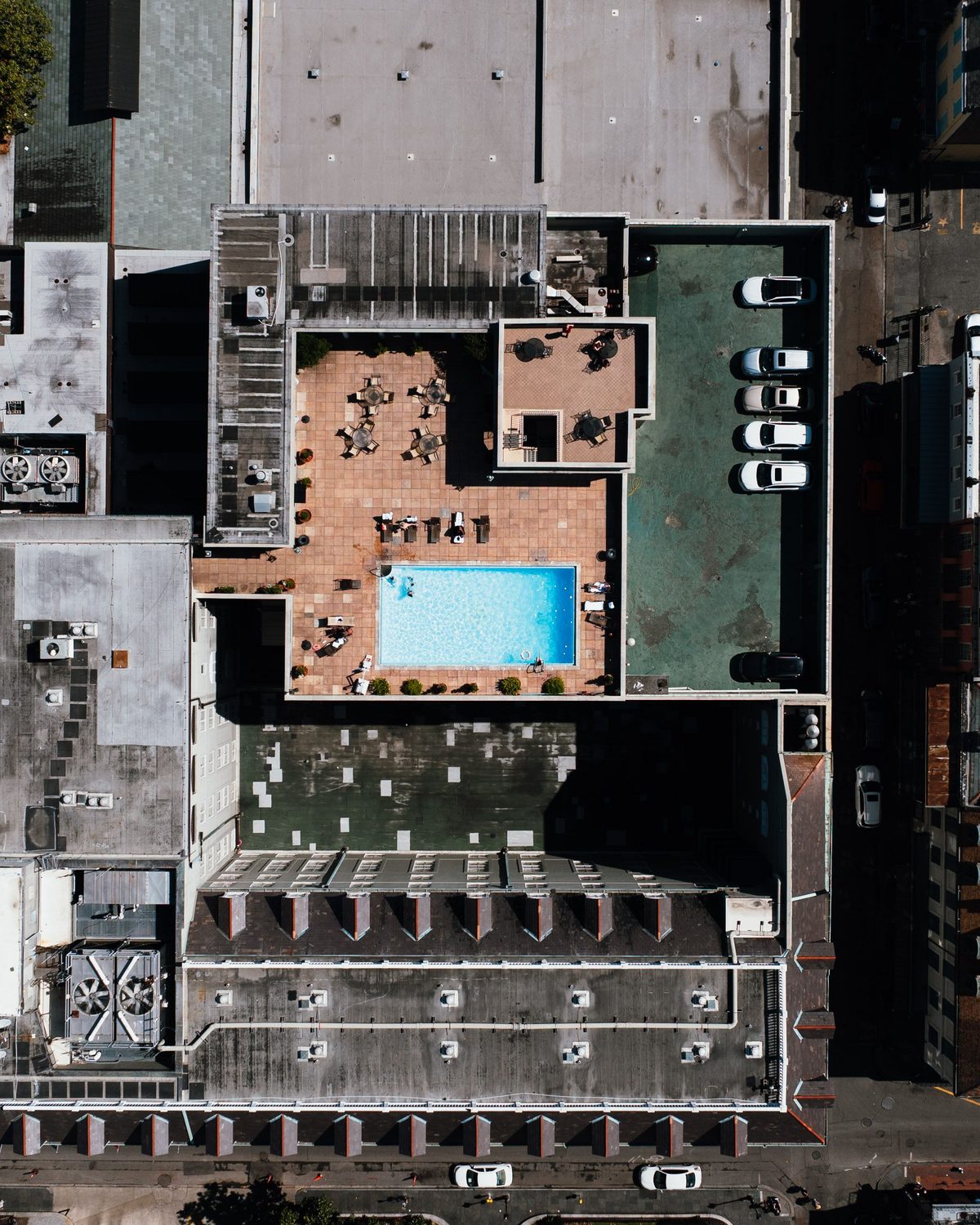
Inspectors choose methods based on what they need to prove. A visual walk finds surface defects. Finding water hidden inside the roof takes additional tools, and each tool answers a narrower question than the one before it.
That sequence is the thing to understand before you approve a price. Methods are not alternatives competing to be the best. They are layers, and the reason an inspection costs what it does is usually how many layers it includes.
The main methods
| Method | What it shows | Limits |
|---|---|---|
| Visual walk | Surface defects, flashings, drainage, workmanship | Cannot see inside the roof |
| Drone | Overview photos of large or unsafe roofs | Photos only; still needs hands on checks for details |
| Infrared scan | Temperature differences that suggest wet insulation | Needs the right weather, usually a clear evening after a sunny day |
| Moisture meter | Moisture readings at specific points | Readings must be confirmed |
| Core samples | The actual layers, their condition and whether they are wet | Each core must be patched properly |
How methods work together
A good commercial inspection often combines them. A drone or visual walk maps the roof. An infrared scan flags suspect areas. Moisture meters and a few core samples confirm what the scan suggested. The result is a map of wet and dry areas, which decides whether a roof can be repaired, restored or must be replaced.
The order is deliberate. Each step is broader and cheaper than the one after it, and each one narrows the search for the next. Running the sequence backwards, by cutting cores before anything has been scanned, means paying for accurate answers about randomly chosen spots.
Matching the method to the decision
The useful question is never which method is best. It is which method changes the decision in front of you.
| Your decision | What usually answers it |
|---|---|
| Is the roof leaking, and where from? | Visual walk, working back from the interior stain |
| How bad is storm damage, and how fast can I record it? | Drone photography on the day, then a walk |
| Can this roof be coated or restored? | Moisture survey across the field, confirmed by cores |
| Repair or replace? | Moisture survey, because the wet share of the roof decides it |
| What is the roof worth to a buyer? | Visual walk plus a survey, with a mapped report |
| Why did this detail fail? | Close inspection and, where needed, a core through the detail |
Reading down that list shows why a single price for an inspection means nothing. A walk to find a leak and a survey to support a replacement budget are different products with different tools.
Non destructive and destructive testing
Everything except core cutting is non destructive. Nothing is removed, nothing is opened, and the roof is left as it was found.
Non destructive methods are safe to repeat, which is their real advantage. A survey run every few years from the same grid shows how wet areas are spreading, and a spreading wet area is the clearest signal a roof is coming to the end of its life.
Destructive testing means cutting. It gives certainty about the layers at that point and nothing about the rest, so cores belong at the confirmation stage, in places a scan has already flagged. Agree the number, the locations and the patching method before anyone starts cutting, and check the warranty position first.
What no method finds on its own
Every instrument reads a proxy, so every instrument can be fooled. Infrared reads heat and will flag a warm duct or a dark patch of surfacing as if it were water. A moisture meter reads an electrical property and reacts to a damp surface as readily as to saturated insulation. A drone photograph shows a seam that looks closed and cannot tell you whether it is welded.
The answer is verification. A finding produced by one method and confirmed by another is evidence. A finding from one method alone is a suspect area, and a report should label it as one. If a survey report marks wet areas with no note of how any of them were checked, ask what confirmed them before you spend money on the result.
Questions to ask your inspector
- Which methods will you use, and why?
- What decision will each test change?
- Will you take core samples, and how will you patch them?
- What conditions do you need for the scan, and what happens if the weather is wrong?
- Will I get a moisture map with the report?
The second question is the one that saves money. A test that cannot change what you do next is not worth buying, however impressive the equipment.
See how these results show up in an inspection report, or check what inspections cost once testing is included.
Common questions
Which roof inspection method is the most accurate?
Core samples, because they are the only method that shows the actual layers of the roof and whether they are wet.
- Everything else measures a proxy: a surface, a temperature difference, an electrical property
- Coring is destructive, slow and limited to the spots you choose
- Twelve cores give twelve accurate answers about twelve small circles
- A walk or a flight maps the roof and finds surface defects
- A scan narrows the search to suspect areas across the whole field
Cores confirm what the scan suggested, in the places the scan pointed to. Each method covers the previous one's weakness, and the result is a moisture map you can act on. Judging one method best in isolation misses how they are actually used.
Do core samples damage the roof?
Yes, by design. A core cut makes a deliberate hole through the membrane, the insulation and down to the deck.
- The damage is temporary when the core is patched properly the same day
- Patch materials must match the system and follow the manufacturer's method
- Agree how many cores will be taken and where, to answer a question
- A patch on a welded membrane must be welded, not merely matched in color
- Cutting a warranted roof without an authorized contractor can end the cover
Ask for a photograph of each core, of the layers it exposed and of the finished patch. Those are the evidence behind the wet or dry finding, and your proof the roof was left watertight. An inspector who photographs nothing has given you a hole and an opinion.
When can an infrared roof scan be done?
Infrared works on stored heat, so it needs a dry roof, a sunny day before it and a clear evening after it. The window usually opens an hour or two after sunset.
- Dry areas have given up their heat by then while wet areas are still warm
- Rain, heavy cloud, wind and snow cover all close that window
- It is often a return visit rather than part of the first walk
- Ballast, gravel, a wet surface and some reflective coatings interfere
- It cannot see through a metal roof or a vapor barrier above the wet layer
A scan run in the wrong conditions produces images that look convincing and mean very little, which is worse than no scan. Ask the inspector what conditions they need, and be suspicious of anyone who offers to scan whenever it suits the diary.
Can a drone replace walking the roof?
No. A drone produces photographs and video from above, which is excellent for mapping a large roof and documenting storm damage quickly.
- It cannot probe a seam or press a soft area underfoot
- It cannot open an equipment panel, lift a walkway pad or take a moisture reading
- Those are the checks that find most real defects
- It shortens the walk and gives images comparable year on year from the same path
- On a fragile or very high roof it may be the only safe view
Whether a seam is welded or only looks closed, whether the insulation is wet, whether a condensate line discharges onto the membrane: none of that appears in an aerial photograph. A drone report with no hands on inspection behind it is a set of pictures.
What is the difference between a moisture survey and an infrared scan?
An infrared scan is one way of running a moisture survey, not a separate thing from it. The survey is the job: mapping where water sits inside the roof.
- Infrared reads heat retained by wet material and needs the right weather
- Capacitance meters read near the surface and give point readings, not a picture
- Nuclear gauges detect hydrogen through the full assembly but need licensed handling
- Electrical impedance maps relative moisture across a grid in wider conditions
- Each instrument reads a different property and struggles somewhere different
What you should care about is the deliverable: a moisture map with wet areas marked on a plan, which instrument produced it, and how the readings were verified, usually with cores. A survey without a map is a set of readings.