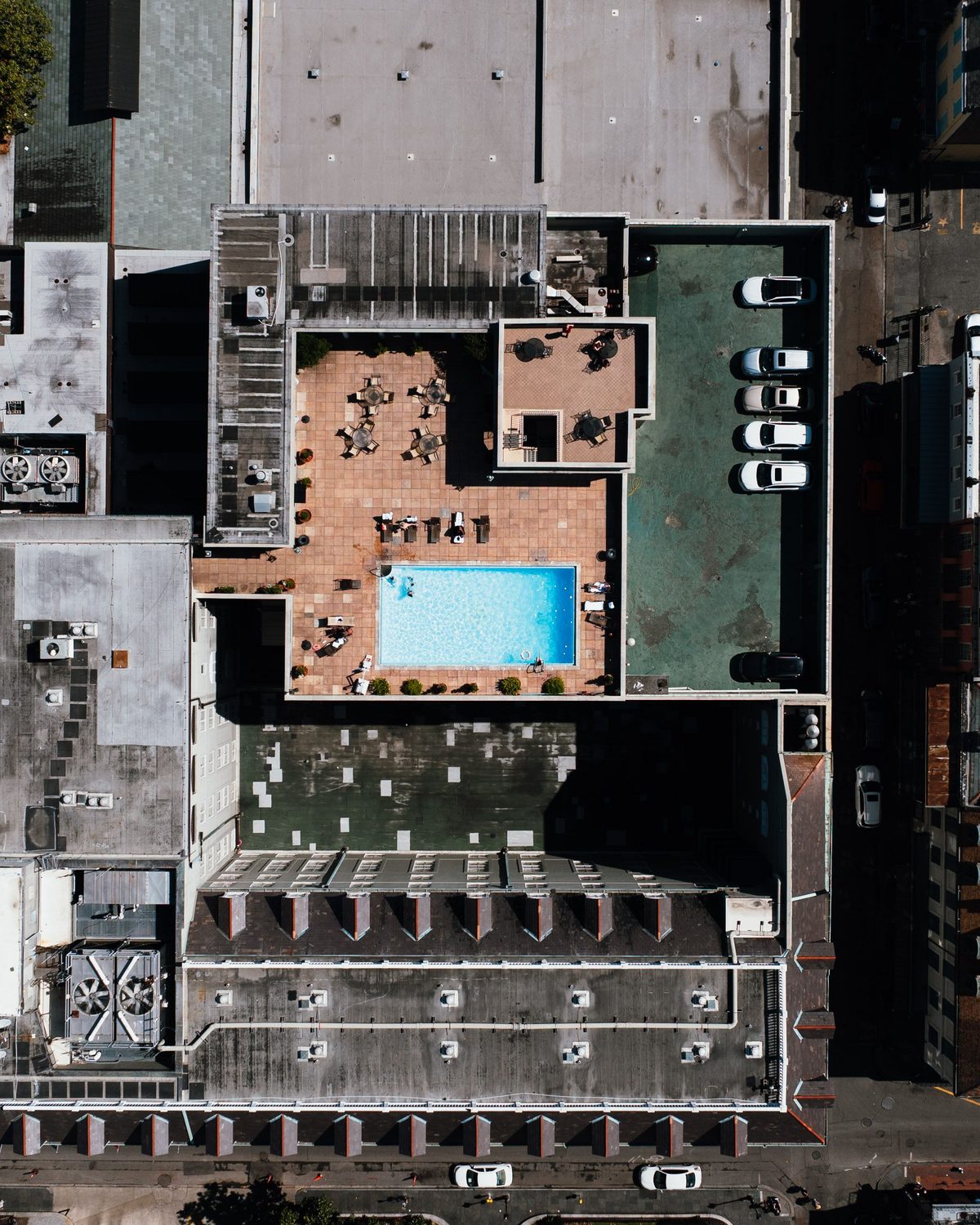
This is a checklist for commissioning and reading an infrared roof moisture survey. It covers what has to be true for the scan to work, what to agree before it happens, and what the report must contain to be worth the fee.
Infrared detects temperature, not water. Everything below follows from that.
Is the roof a candidate?
| Check | Why it matters |
|---|---|
| Surface type | Smooth membrane scans well; heavy ballast and gravel do not |
| Surfacing reflectivity | Highly reflective surfaces can suppress the differences |
| Insulation type | Absorbent insulation gives the clearest signal |
| Build up and air gaps | Vented and air gapped systems read differently |
| Known saturation | A uniformly wet roof can show no contrast at all |
| Access | Walkable roof, or a drone with a radiometric camera |
The conditions on the night
| Require | Why |
|---|---|
| Dry surface | Surface water masks everything beneath it |
| Solar gain during the day | The roof has to be charged thermally |
| Clear sky after dark | A cloudy sky slows radiative cooling |
| Low wind | Wind evens out the differences the camera reads |
| The post sunset window | Short, and the reason scans run in the evening |
| No recent rain | A roof wetted that day is not scannable |
What to agree before it happens
| Agree | Why |
|---|---|
| Confirmation method | Probe, capacitance meter, nuclear gauge or core |
| How many points will be confirmed | A sample, not an assertion |
| Permission for core sampling | And who repairs the cores afterwards |
| Who marks the roof | Marking paint on the roof itself aids later repair |
| Deliverable format | A scaled plan, not only a set of images |
| Rescheduling terms | Scans get moved for weather, and should |
What the report must contain
| Include | Why |
|---|---|
| Scaled plan with anomalies outlined | Area, not dots, is what gets priced |
| Total affected area with units | The figure that drives the decision |
| Paired thermal and visible images | So an anomaly can be placed on the real roof |
| Confirmation results | What was tested, where, and what was found |
| Conditions on the night | Temperature, wind, sky, surface state |
| Limitations | Areas not scanned, and why |
| A recommendation | Repair, partial replacement, or replacement |
Reading the result
| Finding | What it usually means |
|---|---|
| Small isolated areas | A repairable local failure, often at a detail |
| A large continuous area | A recover is off the table; price a replacement |
| Wet areas along a perimeter | A perimeter detail or edge failure |
| Wet areas around equipment | A curb, a fixing, or condensate discharge |
| Wet areas with no path above | Water travelling laterally from somewhere else |
| No anomalies at all | Useful, but not proof the roof is dry |
What to do with it
- Ask whether the roof is a candidate first. Some roofs cannot be scanned usefully.
- Let the surveyor move the date for weather. A scan in poor conditions is worse than none.
- Insist that anomalies are confirmed physically. An image alone is an inference.
- Hold out for an area figure. That is the number that makes a decision.
- Repeat the scan in two years if it is borderline. Spreading and static mean different things.
Want the reasoning behind this? Read the inspection methods and what an infrared inspection involves.
Walked by Date Roof
Common questions
What does an infrared scan actually detect?
Temperature differences at the roof surface, not moisture directly. Wet insulation holds heat longer than dry insulation, so after a sunny day it stays warmer into the evening, and the camera sees that difference as a pattern. The moisture is inferred from the pattern rather than measured.
- The camera reads surface temperature, not water content
- Wet material stores and releases heat more slowly than dry material
- The anomaly is a temperature difference, not a moisture reading
- Findings are confirmed by probe or core, not by the image alone
- A clear scan does not prove a roof is dry everywhere
This distinction matters because thermal images are persuasive and easy to over read. A warm area is a reason to investigate, not a conclusion. Every reputable survey confirms a sample of anomalies by a physical test before reporting them as wet, and a report that skips that step is presenting an inference as a finding.
What conditions does a scan need?
A dry roof surface, a day with enough solar gain to charge the roof, a clear evening so the surface can radiate, low wind, and a scan carried out in the window after sunset while the temperature difference is still developing. Miss any of those and the result is unreliable.
- A dry surface, with no rain or dew during the scan
- Enough sun during the day to charge the roof thermally
- A clear night sky, so the surface can radiate heat
- Low wind, because wind evens out the differences
- The right window after sunset, which is short
This is why scans get rescheduled, and why a surveyor who insists on moving the date is usually doing the right thing. A scan carried out in poor conditions produces an image that looks like a result and is not one, which is worse than no scan at all because somebody will act on it.
Which roofs can and cannot be scanned?
Flat and low slope roofs with absorbent insulation scan well. Ballasted roofs, roofs with heavy gravel surfacing and some highly reflective surfaces are difficult or impossible, and a metal roof with an air gap behind it reads very differently from a built up system.
- Smooth membrane roofs over absorbent insulation scan well
- Ballast and heavy gravel obscure the thermal signal
- Highly reflective surfaces can suppress the differences
- Air gaps and vented build ups complicate interpretation
- Very wet roofs can read as uniformly warm and show nothing
Ask the surveyor before booking whether the roof is a suitable candidate, and expect an honest answer that sometimes means no. Where infrared will not work, nuclear or capacitance moisture meters and core sampling remain available, and a surveyor who offers the alternative rather than scanning anyway is the one to use. Ask what the surveyor would do on this specific roof rather than what infrared can do in general, because the answer to the second question is never the answer to the first.
What should the survey produce?
A marked plan showing the anomalies as areas rather than points, the total affected area as a figure, the confirmation method used, photographs of the verification, and a clear statement of the conditions on the night and any limitations that followed from them.
- A scaled plan with anomalies outlined as areas
- Total wet area stated as a figure, with units
- The method used to confirm, and how many points were tested
- Thermal and visible light images, paired
- Conditions on the night and any limitations
The area figure is the output that matters commercially, because it decides between repair, partial replacement and full replacement, and it feeds straight into a capital plan or a negotiation. A survey that produces images without an area figure has given you something interesting rather than something you can act on. Ask for the plan in a format your roofer can price from, since a figure that has to be redrawn before anybody can quote it will usually be redrawn differently.
How should a scan result change what you do?
A small, isolated wet area is usually a repair. A large or spreading one usually ends the case for a recover and points at replacement. Either way the figure matters more than the images, and the decision should rest on area, location and trend rather than on how dramatic the picture looks.
- Small isolated areas are usually repairable
- Wet insulation does not dry out, so it will not improve
- A large wet area rules out a recover entirely
- Location matters: wet at a detail differs from wet in the field
- A repeat scan after two years shows the trend
Where the result is ambiguous or the area is near the threshold for replacement, a second scan after eighteen months to two years settles it by showing whether the wet area is spreading. Spreading means an active path that has not been found; static usually means a historic failure that has since been repaired.