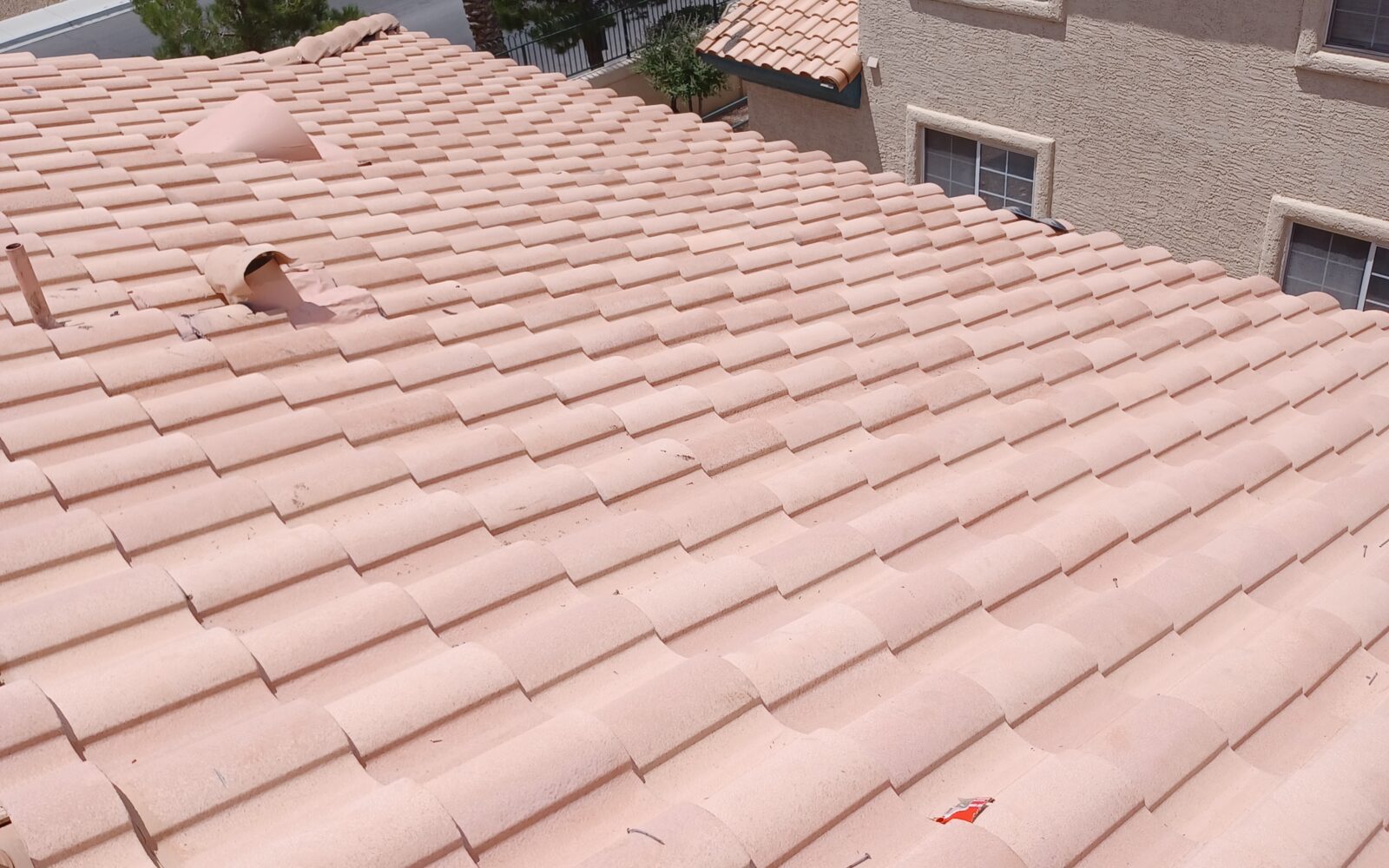
A residential roof inspection is a survey of a house roof carried out to establish its condition and its remaining life. It covers the roof covering itself, every detail around and through it, the drainage, and the underside of the deck from inside. It is not the same thing as a roofer looking at a roof in order to quote for work on it, and the difference shows up in what you receive at the end.
That difference is the reason to be clear about what you are buying. An inspection produces a document: findings, located, photographed and rated, with an opinion on how long the roof has left. A sales visit produces a price. Both have their place, and only one of them helps you decide whether work is needed at all. Our page on what a roof inspection is covers the general case; this one is about houses.
What gets looked at
Four things, in this order, because each one explains the next.
- The covering. Material, age, and how evenly it has worn. Missing, displaced, cracked or lifted units. Granule loss, splitting, curling, or corrosion depending on the material.
- The details. Everywhere the covering stops: against walls and chimneys, at the eaves and rakes, at the ridge and the hips, in the valleys, and around every pipe, vent and rooflight.
- The drainage. Gutters, outlets and downpipes, whether they are clear, whether they are falling the right way, and whether water has been running where it should not.
- The underside. The attic or roof space, which records the history the surface has covered over.
Most leaks on a house come from the second group rather than the first, which is why an inspection that walks the surface and does not get to the details has looked at the least informative part of the roof.
How each covering is read
| Covering | What it fails by | What an inspector looks for |
|---|---|---|
| Asphalt shingles | Granule loss, seal failure, creasing | Bare patches, lifted tabs, exposed nails, creases from wind |
| Concrete or clay tile | Cracking, slipped units, underlayment age | Broken and slipped tiles, mortar loss at ridges, daylight below |
| Slate | Delamination, nail fatigue, flashing age | Flaking faces, slipped slates, condition of valleys and leadwork |
| Metal panels | Fastener and lap failure, cut edge corrosion | Backed out screws, open laps, rust at ends and penetrations |
| Low slope sections | Ponding, seam failure, poor terminations | Standing water, open laps, short upstands at walls |
| Wood shakes | Splitting, cupping, biological growth | Split and lifted shakes, moss holding moisture, failed valleys |
On most houses more than one of these is present, because a porch, a dormer or an extension frequently carries a different covering from the main roof. Those junctions are where the attention belongs: two systems meeting is a detail, and details are what leak. Our roof inspection checklist sets out the item by item version of this.
Walking the roof, and when nobody should
The surface is best assessed from the surface, and that is the default. It is not always the right call.
A brittle tile roof, a steep slate, a wet or frosted surface, a deck that already feels soft, or a covering at the end of its life can all be damaged by being walked on, and the damage is real rather than theoretical. The professional answer in those cases is to say so and use something else: a drone or pole camera for the surface, access from the inside for the deck, and a ladder survey of the eaves and the lower details. Our pages on inspection methods and drone roof inspection cover what each approach can and cannot establish.
What matters is that the report states which parts were examined and how. A survey that quietly covers the whole roof when half of it was never reached is worse than one that admits the gap.
Inside the building
The attic is the most underused part of a residential roof inspection. The surface tells you what the roof looks like now; the underside tells you what has already happened to it.
Staining on the sheathing locates leaks that have since been patched over. Daylight visible at a lap or around a fixing marks a gap the covering should be closing. Rust on the points of nails coming through the deck indicates condensation rather than a leak, which is a ventilation problem and not a roofing one. Blocked eaves vents, insulation stuffed into the ventilation path, and bathroom extracts discharging into the roof space all shorten the life of the covering above them without ever showing on the surface.
Gutters, downpipes and the ground
The drainage below the roof gets looked at least and explains a surprising number of complaints. Gutters that have dropped out of fall hold water and sag further. Joints that have opened discharge against the fascia, which is where rot on a house usually starts. Downpipes that run straight onto the ground at the foundation saturate it, and a basement or crawl space complaint is sometimes a roof drainage problem that nobody connected to the roof.
An inspector should check that water leaves the roof, travels through a gutter that falls to its outlet, goes down a pipe that is attached and clear, and ends up somewhere away from the building. Each of those four can be confirmed from the ground in a few minutes, and each one failing costs more to repair in the structure than in the gutter.
How this differs from a commercial inspection
The principles are identical and three practical things change. House roofs are mostly pitched, so the covering sheds water quickly and the failure points are the junctions rather than the field. Access is from ladders rather than a hatch or a stair, which makes weather and safety a bigger constraint. And there is usually no plant on the roof, so the penetrations are few and small instead of many and large.
The instrumented methods carry over where they are worth it. An infrared roof inspection is most useful on the low slope parts of a house, where trapped moisture sits in an insulated assembly rather than drying out between rain.
What you should receive
A residential inspection should leave you holding:
- Photographs of every elevation and every finding, dated
- Each finding located on the roof, not just listed
- A rating that distinguishes urgent from monitor from cosmetic
- The covering material and its approximate age
- An opinion on remaining serviceable life, with reasoning
- A plain statement of anything not examined, and why
What it does not have to include is a price for the work. Our reports page covers what a usable document looks like, and roof inspection cost covers what moves the figure for the survey itself.
Who should do it
Somebody who inspects roofs regularly, carries their own insurance, and has no stake in the repair being needed. That last point is the one that quietly decides the value of the document. Where an inspection is free, it is usually a sales visit, and our page on free roof inspections sets out what that is and is not good for. Choosing a roof inspector covers what to ask before booking.
Where to go next
Book one when you buy, when you sell, after any storm that took material off anything in the neighborhood, when the roof passes the age where its covering typically starts failing, and once a year after that. If a storm is the reason you are reading this, a hail damage roof inspection is a different survey with a different output, and it is worth asking for the right one.
Common questions
Does a home inspection include the roof?
It includes a look at the roof, which is not the same thing. A general home inspector reports on the roof as one of many systems, usually from the ground, a ladder or a window, and is not required to walk it. The result is a note, not a condition survey.
- A general inspection covers the whole house briefly
- Most standards do not require walking the roof
- Findings are often qualified by limited access
- No measurement of remaining life is usually given
- A recommendation to get a roofer out is common
That is not a criticism of home inspectors, whose brief is breadth. It just means the roof section answers a different question from the one a buyer or an owner usually has, which is how many years are left and what the next five will cost. When a home inspection flags the roof, the sensible next step is a survey by somebody who inspects roofs specifically, with the ladder, the access equipment and the reason to look at the details rather than the surface.
Can a roof be inspected from the ground?
Partly, and it is often the right place to start. From the ground you can read the lines of the roof, see displaced or missing material, spot sagging, check the gutters and the fascia, and photograph each elevation. What you cannot do is assess the surface, the fixings or any of the details.
- Lines, sag and missing material show up from below
- Gutters, fascia and soffit are visible and informative
- Surface condition needs the roof itself
- Seals, laps and flashings cannot be judged at distance
- Binoculars and a long lens extend the view, not the verdict
A ground survey is also the only option on some roofs, and saying so is better than guessing. Very steep slate, brittle tile, failing decking and wet or icy conditions all make walking a roof unsafe or damaging, and a good inspector will refuse rather than risk it. The answer then is a drone or a pole camera for the surface, plus access from inside to read the underside, and a report that states plainly what was and was not examined.
Does a residential roof inspection include the attic?
It should, wherever there is access. The underside of the deck shows things the surface hides: water staining, daylight at laps and fixings, rusted nail points from condensation, mold growth, compressed or displaced insulation, and blocked ventilation at the eaves.
- Staining locates past leaks the surface has closed over
- Daylight marks gaps the covering should be closing
- Rusted nail points indicate condensation, not a leak
- Blocked eaves ventilation shortens the roof's life
- Insulation condition explains a lot of heat complaints
The distinction between condensation and a leak is the one worth having drawn for you, because they look similar on a ceiling and the fixes are nothing alike. A leak enters at a point and tracks; condensation appears generally on the cold surfaces and around the fixings, worst in winter and worst where moist air escapes from the rooms below. An inspection that reports wet without separating the two leaves the owner to pay for the wrong repair.
Do I need a roof inspection to sell my house?
Not as a rule, but it changes who controls the conversation. A current report commissioned by you arrives before the buyer's inspector does, with findings described in your words and quantified. Without one, the roof is first described in the buyer's report, which is written to protect the buyer.
- A seller's report sets the baseline before negotiation
- Findings can be priced and fixed in advance
- Surprises late in a sale cost more than repairs
- A report with photographs answers questions remotely
- It is no substitute for disclosing what you know
Where it earns its cost most clearly is on a roof in the middle of its life, the sort that looks tired and has years left. That roof is easy to characterize as near the end by somebody who glanced at it, and a measured report is the only thing that answers back. On a roof that is genuinely finished, a report simply tells you the number you will be negotiating about, which is still better than finding out during the inspection period.
My insurer asked for a roof inspection before renewal. What do they want?
Evidence of the roof's age, covering type and current condition, usually with photographs of each elevation and a statement of remaining life. Carriers increasingly ask for this on older roofs because the roof is the part of a house most likely to produce a claim.
- Age and material of the covering, stated plainly
- Photographs of every elevation, dated
- Condition of the surface, details and drainage
- An opinion on remaining serviceable life
- Any defect that could cause imminent damage
Ask the carrier what form they want it in before booking anything, because some accept a standard condition report and others have their own template or a certification form with specific wording. Supplying the wrong document means paying for a second visit. It is also worth asking what happens to findings: a report noting repairs that are then completed and photographed is normally a better outcome than a report that is never followed up.